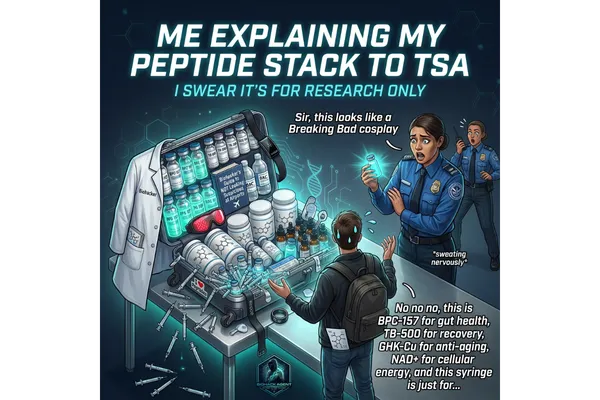
How to Travel With Peptides Without Getting the Pablo Escobar Treatment
Everything you actually need to know — from someone who's done it, not someone who Googled it.
Let me paint you a picture.
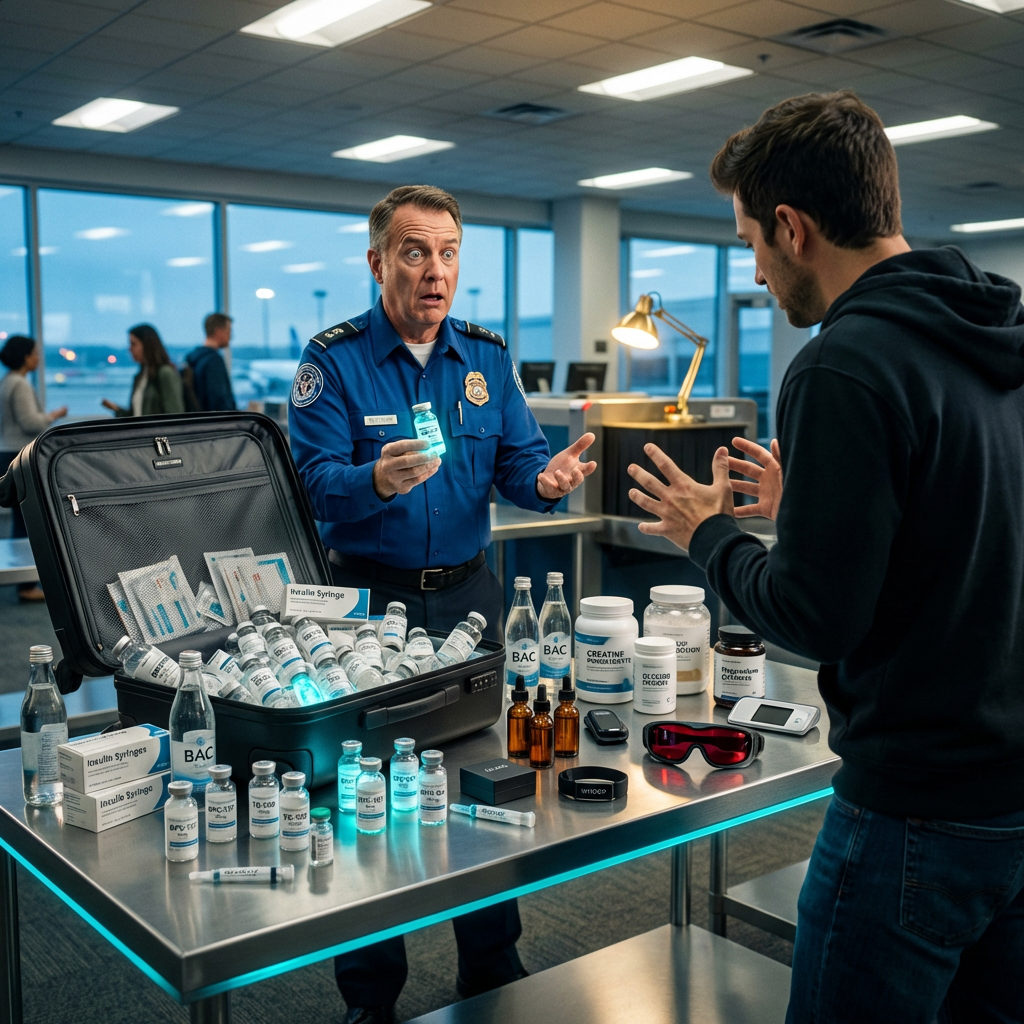
You're standing at TSA. You packed smart. You feel good. And then the agent pulls your bag for secondary screening, unzips it, and sees 14 glass vials, a bag of syringes, alcohol swabs, and an ice pack slowly sweating through your favorite shirt.
The agent looks at you. Looks at the bag. Looks at you again.
And for about 4.5 seconds, you are Pablo Escobar.
If you've ever traveled with peptides — or you're about to for the first time — you've probably stress-Googled this at 2am the night before your flight. The forums are a mess. Half the answers are from 2019. Some guy on Reddit swears you need a notarized letter from three physicians. Another guy says he flew internationally with a duffel bag full of HGH and nobody blinked.
So here's the real answer, based on how this actually works in practice.
First — understand what TSA actually cares about
TSA's job is to find weapons and explosives. That's it. They are not the DEA. They are not customs enforcement. They are not your pharmacist.
Every single day, TSA agents see thousands of travelers carrying injectable medications — insulin, testosterone, HGH, fertility drugs, blood thinners. Your vial of BPC-157 sitting in a cooler pouch does not make their top 500 list of interesting things they've seen that shift.
The vast majority of people who travel with peptides domestically report the exact same experience: nothing happened. Nobody asked. Nobody cared.
But "nothing happened" doesn't get upvotes on Reddit, so you never hear those stories. You only hear from the one person who got a question — and even then, the answer was "it's medication" and they moved on.
The organization rule
Here's where 90% of the anxiety is actually solved.
When TSA opens a bag and sees a clean, organized medical kit — insulated pouch, labeled vials, syringes in sterile packaging, alcohol swabs, maybe an ice pack — their brain immediately categorizes it as "medical supplies" and moves on. They see this constantly.
When they open a bag and find loose vials rolling around in a Ziploc next to your deodorant, unlabeled, with a random syringe shoved in a sock — that looks suspicious. Not because of what it is, but because of how it's presented.
Perception is everything. An insulin travel case from Amazon costs about $15. It holds your vials upright, keeps them cold, and instantly communicates "this person is managing a medical protocol." That $15 is the best money you'll spend on travel peace of mind.
Yes, syringes are allowed in carry-on
This surprises a lot of first-timers, but TSA explicitly permits syringes in carry-on luggage when they accompany injectable medication. You do not need to pre-declare them. You do not need to flag down an agent and announce that you're carrying sharps. Just keep them with your vials in your medical kit.
This policy exists because millions of Americans travel daily with insulin, EpiPens, and other injectable medications. The infrastructure is built to accommodate this. You're not an edge case — you're the norm.
The prescription letter debate
This is where the internet gets dramatic.
Should you carry a letter from your prescribing provider? It doesn't hurt. If you got your peptides through a telehealth clinic or compounding pharmacy, having a letter on your phone takes zero effort and adds a layer of documentation if anyone ever asks.
Has anyone actually been stopped and required to produce one for a domestic flight? In practice, almost never. Most peptides are not scheduled controlled substances. BPC-157, TB-500, GHK-Cu, CJC-1295, Ipamorelin — none of these are on the DEA's controlled substance list.
That said — there's a difference between "required" and "smart." A letter costs you nothing and covers you in the 0.1% scenario where an agent is having a particularly thorough day. Keep a PDF on your phone. Move on with your life.
The temperature problem
This is actually the thing you should be stressed about — not TSA.
Reconstituted peptides are fragile. They need to stay refrigerated, ideally between 36-46°F (2-8°C). A vial of reconstituted BPC-157 sitting in a hot cargo hold for three hours? That peptide is degrading. You might as well have packed water.
Rule #1: Never check your peptides. Ever.
Cargo holds are not temperature controlled for pharmaceuticals. Your carry-on, sitting under the seat in front of you in an air-conditioned cabin, is the only acceptable option.
Rule #2: Frozen gel packs are TSA-approved.
You can bring frozen ice packs through security. Throw two in your insulated case and your cold chain stays intact for a full travel day. Some travelers use the HydroFlask-style insulated pouches. Others use purpose-built insulin coolers with built-in gel packs. Both work.
Rule #3: If you can travel with lyophilized powder, do that.
Unreconstituted peptides — the freeze-dried powder still sealed in the vial — are dramatically easier to travel with. They're stable at room temperature for reasonable periods. No cold chain stress. No worrying about the vial cracking from temperature swings.
If your trip is short enough, bring the powder and a vial of BAC water. Reconstitute when you arrive. Problem solved.
Domestic vs. international — two completely different games
Everything above applies to domestic U.S. travel. And domestically, this is genuinely a non-event for the vast majority of travelers.
International travel is a different conversation entirely.
Every country has its own regulations around importing injectable substances. Some countries won't blink. Others will flag anything injectable at customs, ask for documentation, and potentially confiscate products they can't verify.
Before any international trip, you need to research the specific regulations of your destination country. What's perfectly fine flying from LA to Miami might create a real problem flying from LA to Tokyo or LA to Dubai.
Some general guidance for international travel:
Carry documentation — a prescriber's letter matters significantly more at international customs than domestic TSA
Keep everything in original packaging with visible labels from the pharmacy or supplier
Research whether your specific peptides are classified differently in the destination country
Consider shipping ahead to your hotel through a legitimate channel rather than carrying through customs in high-scrutiny countries
When in doubt, contact the embassy or consulate of your destination country before you fly
This isn't meant to scare you — most international travel with peptides goes smoothly. But the consequences of getting it wrong internationally are meaningfully higher than domestically. Spend 20 minutes researching before your trip.
The actual travel kit
Here's what a clean peptide travel setup looks like:
Insulated medical cooler pouch— insulin-style, compact, fits in your carry-on
2 frozen gel packs— enough for a full travel day
Vials— upright, padded, ideally in original labeled packaging
BAC water— small vial, sealed
Syringes— in original sterile packaging
Alcohol swabs— travel pack
Sharps container— small travel-size (good practice, also signals legitimacy)
Provider letter on your phone— PDF, easily accessible
Total footprint: about the size of a large toiletry bag. Fits in any carry-on with room to spare.
The bottom line
The single most common thing people say after their first time traveling with peptides is:"I can't believe how much I overthought this."
Pack it clean. Keep it cold. Carry it on. Keep a letter on your phone just in case. And stop reading Reddit threads from 2019.
That's the whole protocol.
📥 Want the complete peptide reference?The free BioHack Agent Protocol Guide covers 260 peptide profiles, 185 stacks, dosing frameworks, and protocol templates — everything you need in one download.
👉 Grab it free at BiohackAgent.com
Educational content only. Not medical advice. Always consult a healthcare professional before starting any peptide protocol.